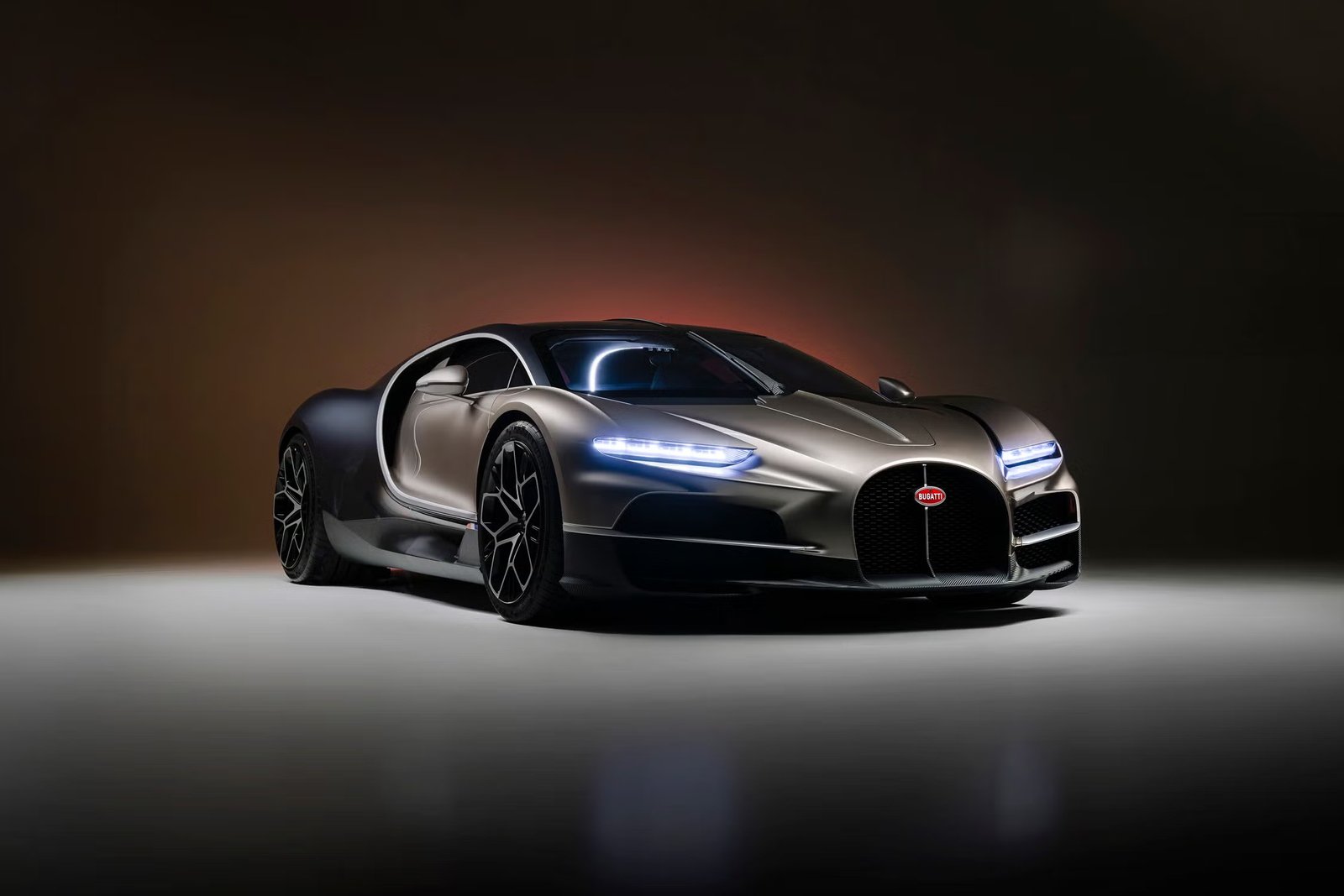
2026 Bugatti Tourbillon Review: The $4 Million Hypercar That Changes Everything
Meta Description: The 2026 Bugatti Tourbillon packs 1,800 hp, a hand-crafted V16 engine, and a watch-inspired interior into just 250 units. Here’s our full review of Bugatti’s boldest hypercar yet.
There are fast cars. Then there are hypercars. And then — somewhere beyond both, in a category so rarefied it barely has a name — there’s the 2026 Bugatti Tourbillon.
Bugatti has spent two decades defining what a hypercar can be, first with the Veyron and then with the Chiron. Both were breathtaking. Both were record-breaking. And both are now officially in the rearview mirror. With the Tourbillon, Bugatti isn’t just replacing a legend — it’s rewriting the rulebook entirely.
So what exactly makes this $4.1 million machine worth the conversation? Quite a lot, as it turns out.
What Is the Bugatti Tourbillon?
The name itself tells you everything about the philosophy behind the car. A “tourbillon” is a 19th-century watchmaking mechanism invented to keep timepieces accurate against the pull of gravity. Bugatti chose that name deliberately, as a nod to precision, mechanical artistry, and timelessness. This isn’t just a fast car — it’s meant to be a rolling heirloom.
Unveiled in the summer of 2024 and set for production deliveries in 2026, the Tourbillon marks the end of Bugatti’s iconic W16 era and the beginning of something genuinely new. Only 250 examples will ever be built, and if reports are accurate, they were all spoken for well before the first one rolled off the line in Molsheim, France.
Engine & Performance: Goodbye W16, Hello V16
This is where things get interesting. After more than 20 years of quad-turbocharged W16 engines, Bugatti made a bold — and controversial — decision. The Tourbillon drops the turbochargers entirely.
In their place sits an all-new 8.3-liter naturally aspirated V16, developed in partnership with Cosworth. It revs to a screaming 9,000 rpm and produces 1,000 horsepower on its own. But that’s only part of the story.
Three electric motors — two at the front axle and one at the rear — add another 800 horsepower, bringing the combined total to a staggering 1,800 hp. To put that in perspective, a Dodge Challenger Hellcat makes 717 hp and most people consider that absurd. The Tourbillon makes more than twice that.
The performance numbers speak for themselves:
- 0–60 mph: Under 2 seconds
- 0–124 mph: Under 5 seconds
- 0–186 mph: Under 10 seconds
- Top Speed: 248 mph (276 mph with the Speed Key on a closed circuit)
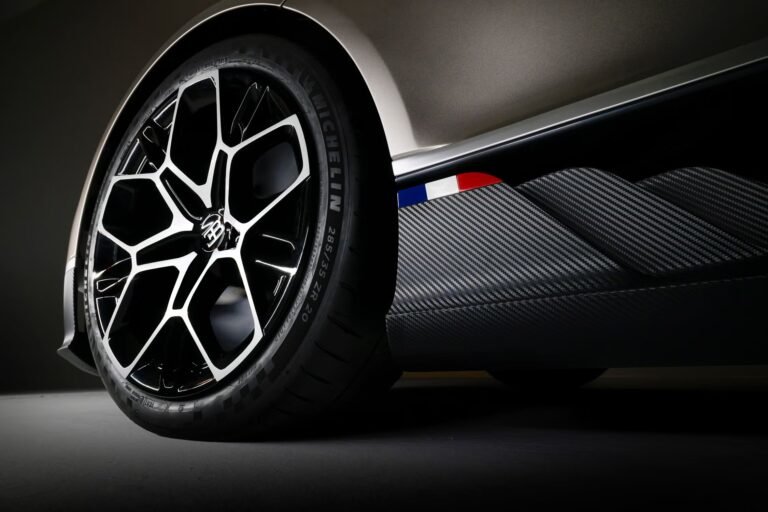
Despite all that power, the Tourbillon is actually lighter than the Chiron — by nearly 150 pounds. Bugatti achieved that through a T800 carbon composite monocoque chassis, AI-assisted 3D-printed suspension components developed with Divergent Technologies, and relentless weight elimination throughout the car. The result is a hypercar that feels nimble as much as it feels ferocious.
Oh, and it can run on pure electric power for up to 37 miles. Because of course it can.
Design: Art That Happens to Hit 276 MPH
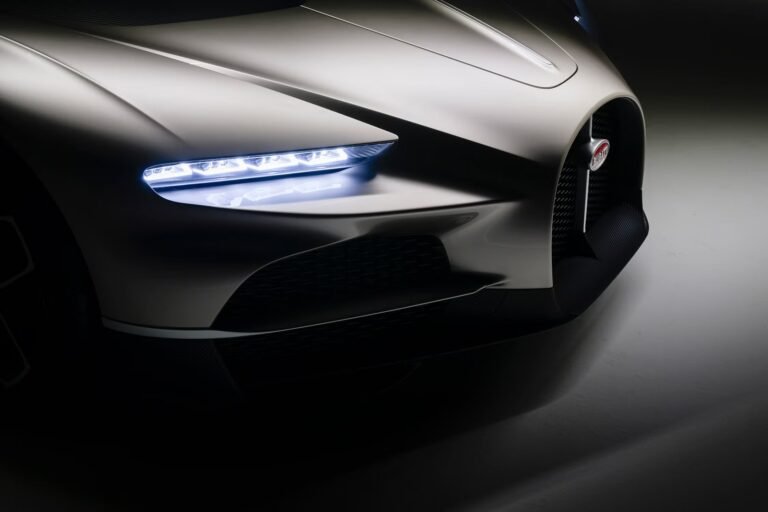
Stand in front of the Tourbillon and you’ll immediately recognize it as a Bugatti. The horseshoe grille, the distinctive Bugatti line, the dual-tone paint split — all the signatures are there. But the Tourbillon is wider, lower, and more dramatic than anything the brand has produced before.
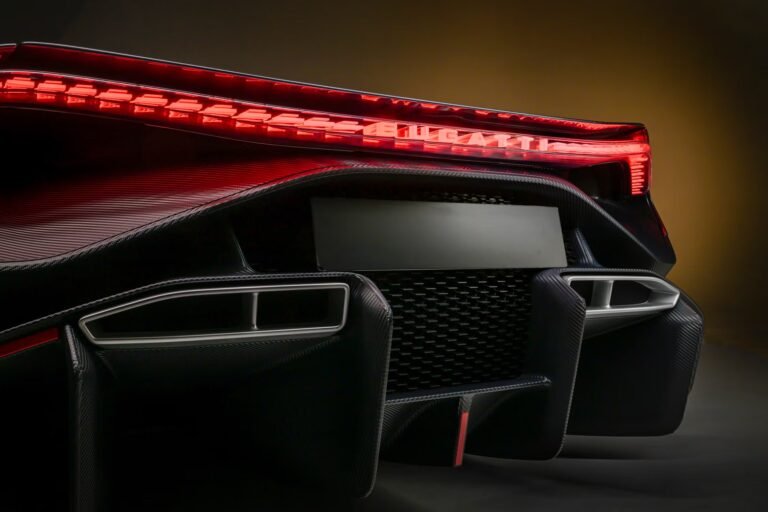
The most striking exterior detail is the butterfly doors, which integrate with the roofline and swing open in a single, flowing motion. At the rear, a single unbroken taillight runs the width of the car — a piece of design so clean it almost doesn’t look real. The entire silhouette was inspired by the peregrine falcon, one of nature’s most aerodynamically efficient hunters. It’s a fitting reference for a car that doesn’t need a rear wing to achieve its top speed.
Interior: A Watch You Can Drive
If the exterior is dramatic, the interior is in a class of its own.
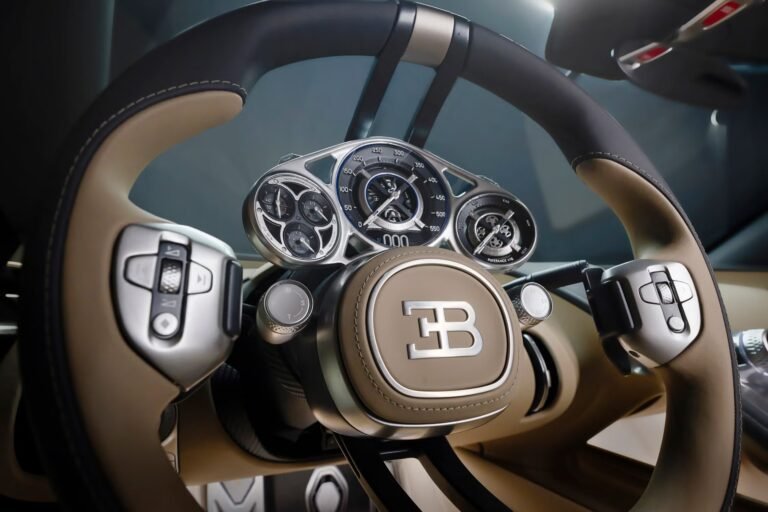
Bugatti made a very deliberate choice here: no large touchscreens. In an era where automakers are cramming tablet-sized displays into everything from minivans to pickup trucks, Bugatti went the opposite direction. The centerpiece of the Tourbillon’s cabin is a fully analog instrument cluster crafted by Swiss watchmakers at Concepto, built to watchmaking tolerances with over 600 individual components made from titanium, sapphire, and ruby.
The steering wheel uses a fixed center hub — meaning only the outer rim rotates — so the gauge cluster is always perfectly visible, no matter where you’re steering. It’s one of the most thoughtful driver-focused designs in any production car, ever.
A retractable digital screen does exist, tucked away until you need it, handling navigation and connectivity without dominating the cockpit. The floating center console is machined aluminum, encased in crystal glass. The seats are fixed to the floor — a weight-saving measure borrowed straight from racing — with the pedals and steering column adjusting to fit the driver instead.
This is what Bugatti means by timeless. A decade from now, that instrument cluster will still look stunning. The same probably can’t be said for the screen-covered dashboards of many of its rivals.
Pros and Cons
What the Tourbillon Gets Right
- Raw, emotional performance at a level no other road car can match
- Hybrid efficiency without sacrificing the soul of a combustion engine
- Cabin design that’s genuinely unlike anything else on the market
- Chassis and weight savings that make 1,800 hp actually manageable
- Investment potential — Bugatti hypercars have historically appreciated significantly
Where It Falls Short
- The price ($4.1 million base, often much more with options) puts it completely out of reach for virtually everyone
- No large digital display may frustrate buyers accustomed to modern tech-forward interiors
- Fixed seats require adaptation if you’re used to adjustable buckets
- Servicing costs will be extraordinary given the complexity of the tri-motor hybrid system
- All 250 units are already sold — you can’t actually buy one at this point
How It Compares to the Competition
| Feature | Bugatti Tourbillon | Pagani Utopia | Koenigsegg Jesko |
|---|---|---|---|
| Horsepower | 1,800 hp | 864 hp | 1,600 hp |
| Top Speed | 276 mph | ~230 mph | 300 mph (est.) |
| Engine | V16 + 3 motors | AMG V12 | Twin-turbo V8 |
| Production | 250 units | 99 units | 125 units |
| Starting Price | ~$4.1M | ~$2.2M | ~$3M |
| Electric Range | 37 miles | None | None |
The Tourbillon sits in a unique position. The Koenigsegg Jesko may claim a higher theoretical top speed, and the Pagani Utopia arguably has a more romantic personality, but no other hypercar combines hybrid technology, this level of power, and this caliber of hand-crafted luxury in one package. The Aston Martin Valkyrie is perhaps the closest rival from a hybrid-hypercar standpoint, but the Tourbillon’s interior craftsmanship and that V16 soundtrack put it in a different conversation entirely.
Real-World Use Cases
Who actually drives a Bugatti Tourbillon, and where?
Collectors and investors are the most obvious buyers. Bugatti’s previous flagship models — the Veyron and Chiron — have both appreciated meaningfully in value, and with only 250 Tourbillons in existence, the same trajectory seems almost certain.
Track day enthusiasts with serious means will appreciate the Tourbillon’s speed key mode, unlocking that full 276 mph potential on a closed circuit. Bugatti hosts exclusive owner events and experiences for exactly this crowd.
Daily drivers in controlled environments — think private estates, coastal drives in Southern California, or European country roads — will find the Tourbillon surprisingly livable. The electric mode means zero-emission, near-silent driving in urban settings, while the adaptive suspension handles real-world imperfections without complaint.
And then there’s the group that simply won’t drive it much at all. That’s not as sad as it sounds. Some machines exist to be admired, shown, and preserved. The Tourbillon, like a fine Swiss watch, has value beyond its function.
Frequently Asked Questions
How much does the 2026 Bugatti Tourbillon cost? The base price is €3.8 million, which works out to approximately $4.1 million before taxes, options, and Bugatti’s extensive bespoke customization program. With personalization, some buyers are spending considerably more.
How many Bugatti Tourbillons will be made? Only 250 units worldwide. All build slots are reported to have been allocated ahead of the production start in 2026.
What engine does the Tourbillon use? It uses an 8.3-liter naturally aspirated V16 developed with Cosworth, paired with three electric motors for a combined output of 1,800 horsepower.
Does the Bugatti Tourbillon have a screen? Yes, but it’s hidden. The cabin prioritizes an analog, watch-inspired instrument cluster as the centerpiece, with a retractable digital screen that appears when needed for navigation and connectivity.
Can the Tourbillon drive on electric power only? Yes. The three electric motors provide up to 37 miles of all-electric range, making the car surprisingly practical for urban driving.
How fast is the 2026 Bugatti Tourbillon? It goes from 0 to 60 mph in under 2 seconds. The standard top speed is 248 mph, which rises to 276 mph when the Speed Key is activated on a closed circuit.
Is the Tourbillon a good investment? Historically, Bugatti hypercars have appreciated in value. The Veyron and Chiron have both commanded prices above their original list in the used market. With only 250 Tourbillons in existence, strong appreciation over time seems likely — though past performance never guarantees future results.
Final Verdict
The 2026 Bugatti Tourbillon is the most complete hypercar ever made. That’s a bold claim, but it’s hard to argue against when you look at what it delivers: 1,800 horsepower from a naturally aspirated V16, a chassis that makes the Chiron feel positively heavy, an interior that belongs in a museum, and a hybrid system that gives it a range and efficiency that would have seemed impossible a decade ago.
It’s not for everyone. In fact, it’s for almost no one — not by price, not by availability, and not by any reasonable definition of practical transportation. But the Tourbillon was never meant to be reasonable. It was meant to be extraordinary. And on that front, Bugatti has delivered something that will be talked about, studied, and admired long after the last one leaves the factory.
Some cars are transportation. Some are performance machines. The Bugatti Tourbillon is something rarer: a statement about what human engineering, at its absolute best, can achieve. And that’s worth paying attention to, even if you’ll never hold the keys.