10 Best Free AI Detectors for Students in 2026
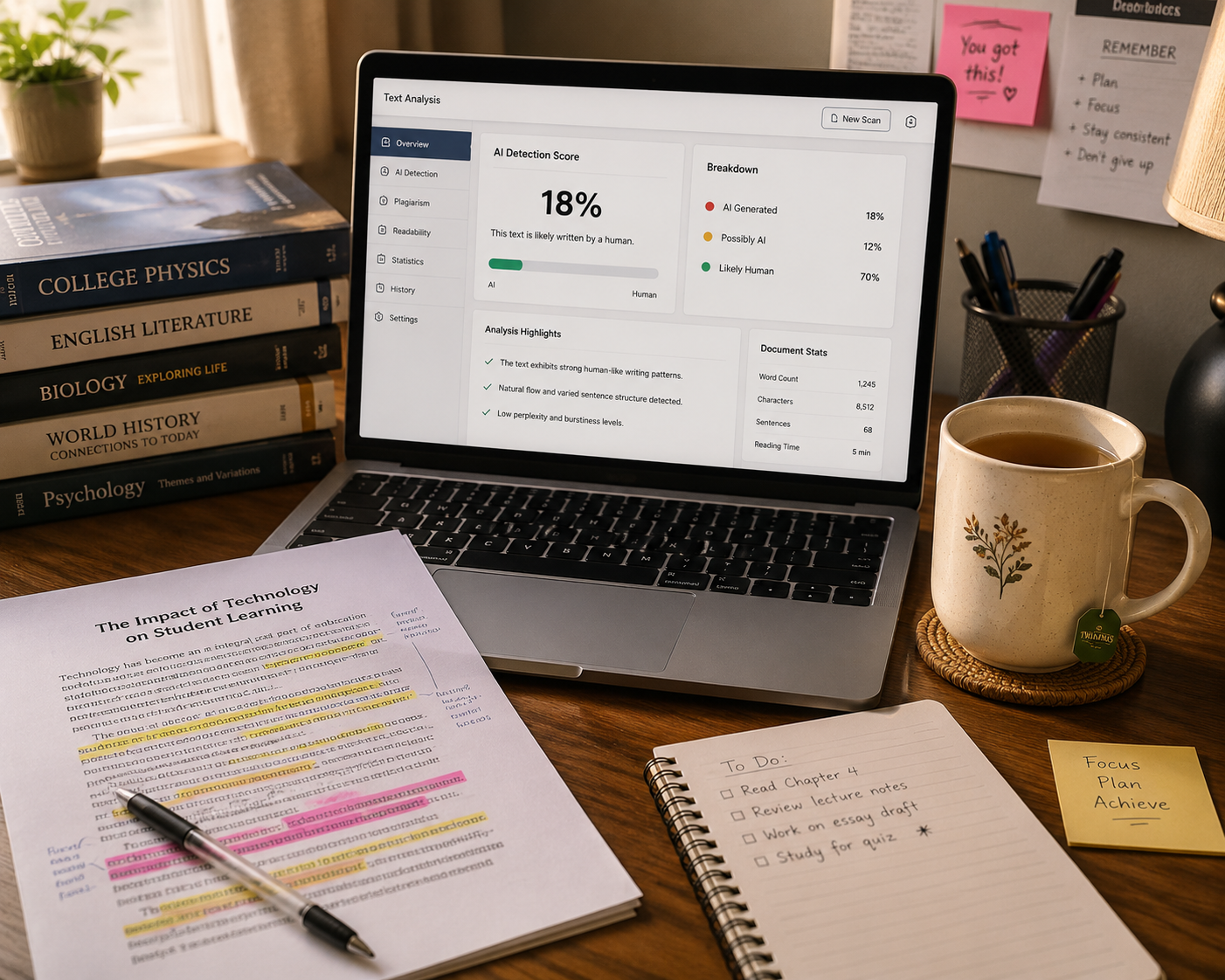
Every student writing an essay these days has probably had this exact worry: what if my professor thinks I used ChatGPT, even though I wrote this myself? With AI writing tools everywhere, schools have gotten stricter, and honestly, some detectors flag completely human writing by mistake. That’s exactly why checking your own work before submitting it has become a smart habit, not just for cheaters, but for honest students who want peace of mind.
I tested a batch of the most talked-about free AI detectors to see which ones are actually reliable in 2026, and which ones you can skip.
Why Students Are Using AI Detectors on Their Own Work
It sounds strange at first, but running your own essay through a detector before turning it in has become common practice. Teachers use these tools too, so previewing the result lets you catch a false flag early, or rephrase a section that reads a bit too “AI-polished” even if you wrote it yourself.
The Best Free AI Detectors to Try
1. GPTZero
Originally built by a Princeton student, GPTZero remains one of the most recognized names in this space. It checks for “perplexity” and “burstiness” — basically, how predictable and varied your sentence patterns are.
Pros: Free tier is generous, fast results, widely used by schools
Cons: Can occasionally flag naturally simple writing as AI-generated
2. Copyleaks
Copyleaks offers a free student-focused checker with decent accuracy across different writing styles.
Pros: Clean interface, supports multiple languages
Cons: Free scans per day are limited
3. Writer.com AI Detector
This tool is straightforward — paste your text, get a percentage score.
Pros: No signup required for quick checks
Cons: Less detailed breakdown compared to competitors
4. Content at Scale Detector
Built originally for marketers, but students have started using it because of its clear scoring system.
Pros: Simple color-coded results
Cons: Occasional inconsistency on shorter texts
5. Sapling AI Detector
Sapling highlights specific sentences it suspects are AI-written rather than just giving an overall score.
Pros: Sentence-level detail helps you fix specific parts
Cons: Interface feels a bit more technical
6. Scribbr AI Detector
Popular in academic circles, Scribbr’s tool is built with students specifically in mind.
Pros: Free, no account needed, quick turnaround
Cons: Word limit on free checks
7. ZeroGPT
A no-frills option that’s been around a while and still performs reasonably well.
Pros: Completely free, no sign-up
Cons: Ads can be distracting
8. Originality.ai (Free Trial)
More commonly used by professionals, but its trial credits are enough for occasional student use.
Pros: High accuracy reputation
Cons: Not fully free long-term
9. Crossplag
A lesser-known tool that combines plagiarism and AI detection in one scan.
Pros: Two checks in one, useful for research papers
Cons: Slower processing time
10. Grammarly’s AI Detection Feature
If you already use Grammarly for grammar checks, its built-in AI detector is a convenient bonus.
Pros: Combines editing and detection in one place
Cons: Full detection feature may require premium
Real-World Use Cases
A high school senior mentioned running her college application essay through GPTZero just to be safe, since a lot of admissions offices now use similar tools. A grad student writing a thesis used Sapling to identify sentences that read too uniformly, then rewrote them in her own natural voice, not because she used AI, but because her academic writing style happened to sound repetitive.
Comparison at a Glance
| Tool | Free Scans | Best Feature | Signup Needed |
|---|---|---|---|
| GPTZero | Generous | School-trusted accuracy | No |
| Copyleaks | Limited | Multi-language support | Yes |
| Sapling | Moderate | Sentence-level flags | No |
| Scribbr | Limited | Academic focus | No |
| ZeroGPT | Unlimited | Completely free | No |
Frequently Asked Questions
Are free AI detectors accurate enough to trust completely?
They’re helpful as a guide, but no detector is 100% accurate. Treat results as a warning sign to review your writing, not as a final verdict.
Can AI detectors falsely flag human writing?
Yes, this happens more often than people think, especially with simple, repetitive, or very structured writing styles.
Should I rewrite my essay if it gets flagged, even though I wrote it myself?
It’s worth adding more personal voice, varied sentence length, or specific examples, since these naturally lower AI-detection scores.
Do teachers rely only on these tools to catch AI-written work?
Most teachers use detectors as one signal among several, including comparing writing style to a student’s past work.
Final Thoughts
AI detectors aren’t perfect, but they’ve become a useful safety check for honest students navigating a world where AI writing tools are everywhere. Running your essay through a free detector before submitting takes two minutes and can save you an awkward conversation with your professor later. Just remember: no tool replaces genuine, thoughtful writing in your own voice.